 BUY THIS MAGNET · $9.99
Scientists burn replica scrolls so ancient books can stay closed and still be read
What happened
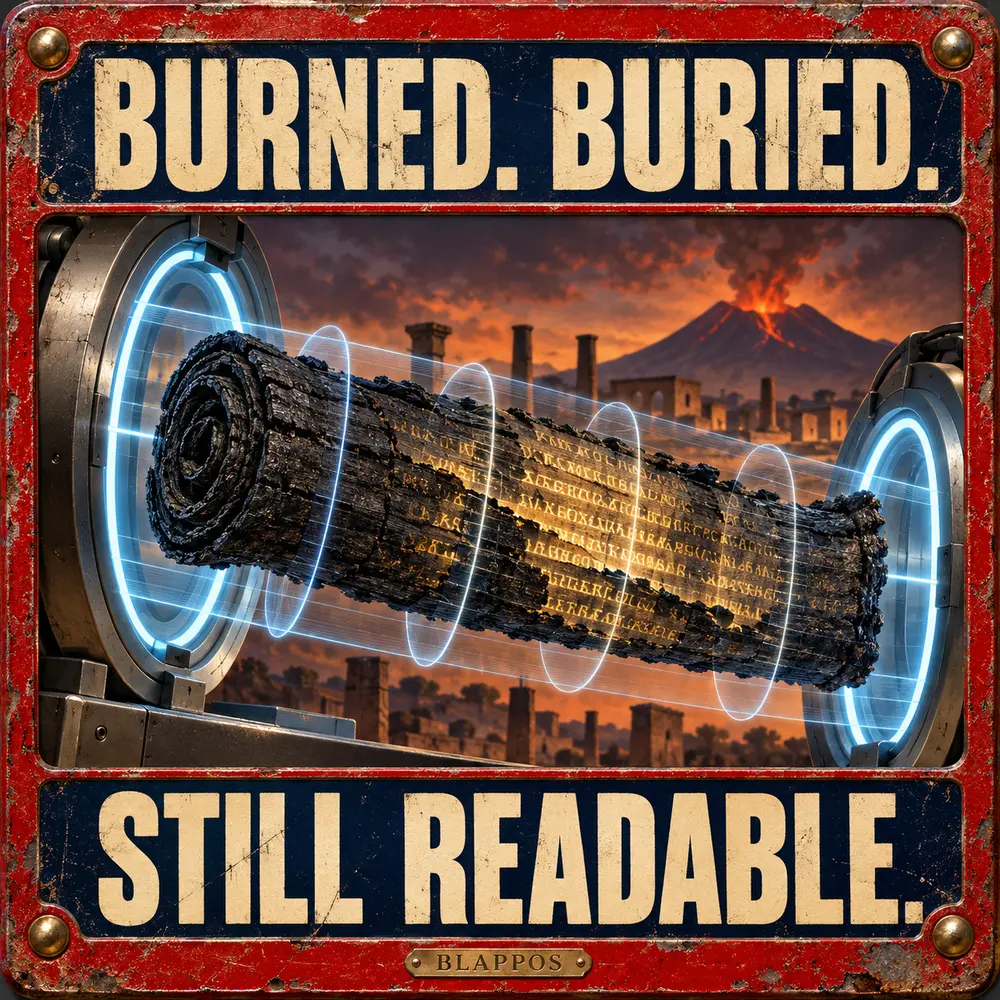
Researchers made replica papyrus scrolls with lampblack inks containing measured amounts of lead, carbonized them in low oxygen and scanned the sealed rolls with X-rays. The PLOS ONE study found that CT imaging could detect ink containing as little as 25 micrograms of lead per square centimeter and that lead could increase X-ray absorption by as much as 25-fold.
Why it matters
Hundreds of Herculaneum scrolls carbonized by Mount Vesuvius are too fragile to open physically. The experiment supplies a calibrated way to identify rolls whose metal-bearing ink may be especially readable by X-ray and to prioritize them for virtual unwrapping. It improves the search strategy; it does not mean every sealed scroll has already been decoded.
The Blappos angle
Verified facts end above. Archaeology has reached the stage where scientists carefully burn a new book to learn how not to open an old one. The best library card is now a CT scan.
Read the September 26 UC Berkeley research report ↗Blappos is commentary. Artwork is illustration—not documentary photography—and the joke is not a substitute for the linked reporting. Check this story’s source ledger or read our sourcing, satire and corrections standard.
Share this disaster
Send the permanent story link—with this story’s illustration—to somebody who needs to see it.
Put this disaster on your refrigerator.
A 3-inch square Blappos magnet, printed to order and shipped by Printify.
BUY THIS MAGNET — $9.99 ↗ Shipping calculated by Printify.Three ridiculously relevant Amazon finds
As an Amazon Associate, Blappos may earn from qualifying purchases. Product availability and pricing can change.